Small businesses no longer need massive advertising budgets to compete with established brands. With the right digital marketing strategy, a local shop, professional service provider, startup, e-commerce store, restaurant, contractor, or home-based business can reach highly targeted customers, build trust, generate leads, and increase sales.
For small businesses in the United States and around the world, digital marketing creates an opportunity to compete where customers are already spending their time: Google, social media, websites, email, YouTube, online marketplaces, and mobile devices.
The U.S. small-business market alone represents an enormous opportunity. According to the U.S. Small Business Administration’s 2026 data, the United States has more than 36.2 million small businesses, representing 99.9% of all businesses and employing 62.3 million people. (SBA Advocacy)
This guide explains what digital marketing is, why it matters for small businesses, which channels to prioritize, how much to invest, and how to create a practical strategy that can produce measurable business results.
What Is Digital Marketing?
Digital marketing is the process of promoting a business, product, service, or brand through digital channels to attract, engage, convert, and retain customers.
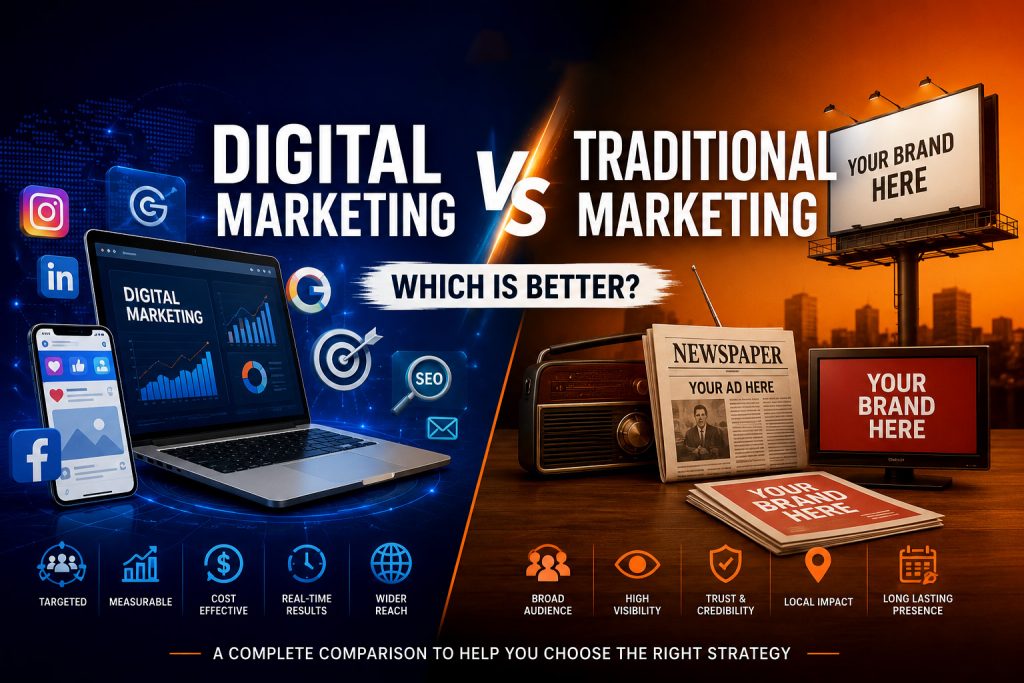
Unlike traditional marketing, which may rely heavily on newspapers, billboards, radio, television, or printed flyers, digital marketing allows businesses to reach specific audiences and measure results more precisely.
Common digital marketing channels include:
- Search engine optimization (SEO)
- Google Business Profile and local SEO
- Social media marketing
- Content marketing
- Email marketing
- Search engine marketing (SEM)
- Google Ads and paid search
- Social media advertising
- Video marketing
- Influencer marketing
- Website marketing
- Conversion rate optimization
- Online reputation management
- Lead generation
- Marketing automation
The goal isn’t simply to “get followers” or “get website traffic.”
The real objective is to turn attention into relationships, relationships into leads, and leads into customers.
Why Digital Marketing Is Important for Small Businesses
A small business can have an excellent product and still struggle to grow if potential customers cannot find it.
Digital marketing helps solve that problem.
Imagine someone in Dallas searches Google for:
“best plumber near me”
Or a customer in Los Angeles searches:
“digital marketing agency for small business”
Or someone in New York searches:
“best Italian restaurant near me”
These searches represent commercial intent. The person isn’t simply browsing—they may be actively looking for a business.
A strong digital marketing strategy helps your business appear at the right place, at the right time, with the right message.
1. Reach Customers Beyond Your Neighborhood
Traditional local marketing can be limited by geography.
Digital marketing allows a small business to reach customers across:
- A neighborhood
- A city
- A state
- The entire United States
- International markets
An online store can sell nationwide. A software company can acquire customers globally. A consultant can serve clients remotely.
2. Compete With Larger Companies
Large companies often have larger marketing budgets, but small businesses have advantages too.
They can:
- Move faster
- Create highly specialized content
- Build personal relationships
- Focus on specific niches
- Provide personalized customer service
- Become recognized local experts
A small company that dominates a specific niche can often outperform a larger company that targets everyone.
3. Build Trust Before the Customer Contacts You
Today’s customers often research a business before making contact.
They may look at:
- Google reviews
- Website
- Social media
- Testimonials
- Case studies
- Videos
- Photos
- Blog articles
- Pricing information
- Frequently asked questions
Your digital presence therefore becomes part of your sales process.
4. Measure What Is Working
One of the biggest advantages of digital marketing is measurability.
You can monitor:
- Website visitors
- Search impressions
- Search rankings
- Leads
- Phone calls
- Form submissions
- Online purchases
- Advertising costs
- Conversion rates
- Customer acquisition cost
- Revenue generated
This allows a small business owner to invest more heavily in channels that produce results and reduce spending on activities that don’t.
The Most Important Digital Marketing Channels for Small Businesses
A small business does not need to use every marketing channel simultaneously.
The smarter approach is to build a strong foundation and then expand.
1. Website Marketing
Your website is the digital headquarters of your business.
Even if most customers discover you through Google or social media, your website can provide the information necessary to turn visitors into customers.
A professional small-business website should clearly communicate:
- What you offer
- Who you serve
- Where you operate
- Why customers should choose you
- Your products or services
- Your contact information
- Customer reviews
- Testimonials
- Frequently asked questions
- Calls to action
Essential website pages
Depending on your business, consider creating:
- Home
- About
- Services
- Individual service pages
- Products
- Locations
- Contact
- FAQs
- Testimonials
- Case studies
- Blog
Don’t create a website simply because “every business needs a website.”
Create a website that helps customers make a decision.
2. Search Engine Optimization (SEO)
SEO is one of the most valuable long-term components of digital marketing.
Search engine optimization helps improve your website’s visibility in unpaid search results.
For example, a roofing company might target:
- Roofing company in Austin
- Roof repair Austin TX
- Emergency roof repair
- Roof replacement near me
A marketing agency might target:
- Digital marketing agency
- Digital marketing for small business
- SEO services for small business
- Local SEO services
- Digital marketing agency in Houston
SEO can bring highly relevant visitors without requiring you to pay for every click.
Google also emphasizes that organic search visibility does not require paying Google for rankings. Google recommends that small businesses learn fundamental SEO practices and use resources such as its SEO Starter Guide and Search Console. (Google for Developers)
Important SEO areas for small businesses
Focus on:
Keyword research
Understand what your customers actually search for.
On-page SEO
Optimize:
- Page titles
- Headings
- URLs
- Content
- Internal links
- Images
- Meta descriptions
Technical SEO
Improve:
- Website speed
- Mobile usability
- Crawlability
- Indexing
- Structured data
- HTTPS
- Site architecture
Local SEO
Optimize your presence for searches connected to your geographic area.
Content SEO
Create useful content that answers real customer questions.
Off-page SEO
Build legitimate authority through relevant mentions, relationships, digital PR, and high-quality links.
3. Local SEO and Google Business Profile
For local businesses, local SEO can be one of the highest-impact digital marketing investments.
A restaurant, dentist, salon, law firm, plumber, real estate agent, mechanic, contractor, or local retail store should pay particular attention to local search.
Google Business Profile allows eligible businesses to manage how they appear on Google Search and Google Maps at no charge. Businesses can provide information such as hours, website, location, photos, videos, and customer reviews. (Google Support)
Optimize your Google Business Profile
Make sure your profile contains:
- Correct business name
- Correct primary category
- Relevant secondary categories
- Accurate address or service area
- Phone number
- Website
- Business hours
- Holiday hours
- Business description
- Products or services
- High-quality photos
- Videos where appropriate
- Customer reviews
- Helpful responses to reviews
Google states that local results are primarily influenced by relevance, distance, and prominence. Complete and accurate business information can help Google understand how your business relates to searches. (Google Support)
Reviews matter
Encourage genuine customers to leave honest reviews.
Then respond professionally to both positive and negative feedback.
Reviews aren’t just about rankings.
They are also social proof.
A customer comparing two businesses may choose the company with stronger, more recent, and more credible reviews.
4. Content Marketing
Content marketing means creating useful information that attracts and educates your target audience.
Instead of constantly saying:
“Buy from us.”
You provide information that helps people solve problems.
For example, a landscaping company could publish:
- How much does lawn care cost?
- How often should you mow your lawn?
- Best plants for a Texas backyard
- How to prepare your lawn for summer
- DIY landscaping mistakes to avoid
A digital marketing agency could publish:
- What is digital marketing?
- Digital marketing for small business
- How much does SEO cost?
- SEO vs Google Ads
- How to get more local customers
- How to create a digital marketing strategy
This content can attract people at different stages of the buying journey.
The content funnel
Awareness
The customer discovers a problem.
Consideration
The customer researches possible solutions.
Decision
The customer compares providers.
Conversion
The customer contacts or purchases from your business.
Retention
The customer returns and recommends your business.
Effective content marketing supports every stage.
5. Social Media Marketing
Social media gives small businesses an opportunity to communicate directly with their audience.
Depending on your market, useful platforms may include:
- YouTube
- TikTok
- X
Don’t choose platforms simply because they are popular.
Choose platforms where your customers actually spend time.
Examples
A B2B consulting company may prioritize LinkedIn.
A restaurant may prioritize Instagram, Facebook, and TikTok.
A local service company may focus on Facebook, Instagram, Google Business Profile, and YouTube.
An e-commerce brand may use Instagram, TikTok, Pinterest, YouTube, and paid advertising.
What should you post?
Create a mixture of:
- Educational content
- Product demonstrations
- Customer stories
- Behind-the-scenes content
- FAQs
- Testimonials
- Before-and-after examples
- Short videos
- Industry insights
- Company updates
- Offers
- Team content
- Community content
The best social media strategy isn’t necessarily the one that produces the most posts.
It is the one that produces consistent, valuable communication with the right audience.
6. Video Marketing
Video has become an important part of modern digital marketing.
Small businesses can create videos without expensive production equipment.
You can use videos to:
- Explain products
- Demonstrate services
- Answer FAQs
- Introduce employees
- Share customer stories
- Show behind-the-scenes activities
- Provide tutorials
- Compare products
- Explain industry concepts
You can create:
- YouTube videos
- YouTube Shorts
- Instagram Reels
- Facebook videos
- TikTok videos
- LinkedIn videos
One useful long-form video can also be repurposed into multiple pieces of content.
For example:
1 YouTube video → 5 short videos → 5 social posts → 1 blog article → 1 email → multiple graphics.
That is much more efficient than creating every piece of content from scratch.
7. Email Marketing
Social media platforms are valuable, but you don’t own your followers.
Your email list is an audience you can communicate with directly.
Use email marketing to:
- Welcome new subscribers
- Share useful content
- Promote products
- Announce offers
- Follow up with leads
- Recover abandoned carts
- Request reviews
- Retain existing customers
A simple email strategy can start with:
Welcome email → Educational emails → Offer → Follow-up → Customer retention
Don’t send emails merely because you have an email list.
Every email should provide a reason for the customer to open, read, or act.
8. Google Ads and Paid Advertising
SEO can take time.
Paid advertising can generate visibility much faster.
Google Ads can help businesses reach people actively searching for relevant products or services. Google also provides advertising options connected with Search, Maps, Display, and YouTube. (Google Support)
For example, a local HVAC company might advertise for:
“AC repair near me”
A law firm might target:
“personal injury lawyer Chicago”
An e-commerce company might advertise:
“organic walnuts online”
Paid advertising works best when you have:
- A clear target audience
- A compelling offer
- Strong landing pages
- Accurate conversion tracking
- Controlled budgets
- Relevant keywords
- Effective ad copy
- A follow-up process
Don’t send every advertisement to your homepage.
Create landing pages designed specifically for the campaign.
9. Lead Generation
Traffic is not the final goal.
Customers are.
Lead generation converts visitors and prospects into identifiable potential customers.
Examples include:
- Contact forms
- Quote requests
- Consultation bookings
- Phone calls
- Newsletter registrations
- Free trials
- Demo requests
- Downloadable guides
- Coupons
- Appointment bookings
Your website should make the next step obvious.
Instead of simply writing:
Contact Us
Consider more specific calls to action:
Get Your Free Quote
Book a Free Consultation
Request Pricing
Schedule an Appointment
Get Started Today
A strong call to action reduces friction and tells the visitor exactly what to do next.
10. Conversion Rate Optimization
Getting 10,000 visitors isn’t necessarily better than getting 1,000 visitors.
What matters is what those visitors do.
Conversion Rate Optimization (CRO) focuses on improving the percentage of visitors who complete a desired action.
Test:
- Headlines
- Buttons
- Forms
- Images
- Offers
- Testimonials
- Pricing
- Page layouts
- Calls to action
- Landing pages
For example:
If 1,000 people visit your website and 20 become leads, your conversion rate is 2%.
If you improve your website and 40 become leads, you doubled your leads without doubling your traffic.
That’s why digital marketing should not focus only on traffic.
It should focus on business outcomes.
How to Create a Digital Marketing Strategy for a Small Business
A successful strategy doesn’t start with posting on Facebook.
It starts with understanding the business.
Step 1: Define Your Business Goal
Choose a measurable objective.
Examples:
- Generate 50 qualified leads per month
- Increase online sales by 30%
- Generate 20 local calls per month
- Increase organic traffic
- Get 10 new consultation bookings
- Build an email list of 1,000 prospects
Avoid vague goals such as:
“We want more visibility.”
Make the goal measurable.
Step 2: Identify Your Ideal Customer
Create a simple customer profile.
Consider:
- Age
- Location
- Industry
- Income
- Problems
- Interests
- Buying behavior
- Search behavior
- Preferred platforms
- Budget
- Decision-making process
For a U.S. business, this might mean defining customers by city, state, ZIP code, or service area.
The more precisely you understand your customer, the more relevant your marketing becomes.
Step 3: Research Your Competitors
Search Google for your most important services.
Study businesses appearing on:
- Google Search
- Google Maps
- YouTube
Analyze:
- Their websites
- Keywords
- Content
- Reviews
- Offers
- Social media
- Backlinks
- Pricing
- Calls to action
Don’t copy competitors.
Find opportunities they are ignoring.
Step 4: Build Your Keyword Strategy
Keyword research helps identify what your customers search for.
Create three categories.
Informational keywords
Examples:
- What is digital marketing?
- How does SEO work?
- How to promote a small business online
Commercial keywords
Examples:
- Best SEO company
- Digital marketing agency
- SEO services for small business
Transactional keywords
Examples:
- Hire SEO agency
- Buy accounting software
- Book a plumber
- Get a marketing consultation
Your content strategy should target different stages of search intent.
Step 5: Build Your Digital Foundation
Before spending heavily on advertising, establish your foundation.
Set up:
- Professional website
- Google Analytics
- Google Search Console
- Google Business Profile where eligible
- Social media profiles
- Business email
- Conversion tracking
- CRM or lead-management system
- Review-generation process
Google’s own resources emphasize tools such as Search Console for understanding search performance and improving a site’s organic presence. (Google for Developers)
Step 6: Create Valuable Content
Build a content calendar around customer questions.
A simple monthly plan could include:
4 educational blog articles
8–12 social media posts
4–8 short videos
1–2 longer videos
2–4 email campaigns
The exact frequency matters less than consistency and quality.
Step 7: Promote Your Content
Publishing isn’t enough.
Promote your content through:
- Social media
- Communities
- Partnerships
- Digital PR
- Relevant industry websites
- Video platforms
- Paid advertising
Good content deserves distribution.
Step 8: Track Your Results
Monitor metrics such as:
SEO
- Organic traffic
- Search impressions
- Click-through rate
- Keyword visibility
- Organic conversions
Social media
- Reach
- Engagement
- Video views
- Website clicks
- Leads
Advertising
- Cost per click
- Conversion rate
- Cost per lead
- Customer acquisition cost
- Return on ad spend
Business
- Qualified leads
- Sales
- Revenue
- Repeat customers
- Customer lifetime value
Don’t become obsessed with vanity metrics.
A post receiving 100,000 views but producing zero customers may be less valuable than a post receiving 2,000 views and generating five qualified leads.
How Much Should a Small Business Spend on Digital Marketing?
There is no universal marketing budget.
Your budget should depend on:
- Industry
- Average customer value
- Competition
- Profit margins
- Business stage
- Location
- Growth target
- Existing customer base
A startup may initially focus on low-cost strategies such as:
- Local SEO
- Content marketing
- Organic social media
- Email marketing
- Networking
- Referral marketing
Once a channel demonstrates positive results, the business can increase investment.
The important principle is:
Don’t spend more simply because you have money. Spend more when you have evidence that the channel can produce profitable growth.
A Practical Digital Marketing Budget Model
A small business could divide its marketing resources into four areas:
1. Foundation — 20%
Website, analytics, tracking, branding, technical improvements.
2. Organic Growth — 30%
SEO, content marketing, local SEO, social media, email.
3. Paid Growth — 30%
Google Ads, Meta Ads, YouTube Ads, or other relevant advertising.
4. Testing — 20%
Experiment with:
- New channels
- New offers
- Landing pages
- Video
- New audiences
- New content formats
The percentages are not rules.
They are a framework for thinking about allocation.
Digital Marketing Mistakes Small Businesses Should Avoid
1. Trying to Be Everywhere
You don’t need ten social media accounts.
Choose the platforms that matter most to your customers.
2. Focusing Only on Followers
Followers don’t automatically equal revenue.
Focus on customers, leads, engagement quality, and conversions.
3. Ignoring Local SEO
If your business serves a local market, ignoring Google Maps and local search can mean missing high-intent customers.
4. Buying Fake Reviews
Never build your reputation on fake reviews.
Encourage genuine customers to share honest experiences.
5. Publishing Without a Strategy
Random content rarely creates predictable growth.
Every piece should have a purpose.
6. Ignoring Mobile Users
A large portion of online activity occurs on mobile devices.
Your website must be easy to navigate and use on smaller screens.
7. Sending All Traffic to the Homepage
Create dedicated landing pages for important campaigns and services.
8. Expecting Immediate SEO Results
SEO is usually a long-term investment.
Google itself notes that small businesses can perform much of their foundational SEO work themselves, while also recommending professional assistance when appropriate. (Google for Developers)
9. Not Tracking Conversions
Without tracking, you don’t know which marketing activities generate customers.
10. Changing Strategy Every Week
Marketing requires testing and patience.
Give a strategy enough time to generate meaningful data before abandoning it.
A 90-Day Digital Marketing Plan for Small Businesses
Days 1–30: Build the Foundation
Focus on:
- Website audit
- Keyword research
- Competitor research
- Google Business Profile
- Analytics
- Search Console
- Conversion tracking
- Social profile optimization
- Website technical SEO
- Service pages
- Basic content strategy
The goal is to create a strong digital foundation.
Days 31–60: Start Growing
Focus on:
- Publishing SEO content
- Local SEO
- Social media content
- Video marketing
- Review generation
- Email list building
- Internal linking
- Digital PR
- Lead-generation campaigns
Start identifying which channels generate the strongest signals.
Days 61–90: Optimize and Scale
Analyze:
- Traffic
- Leads
- Calls
- Sales
- Rankings
- Engagement
- Advertising performance
Then:
- Improve high-performing pages
- Expand successful keywords
- Increase investment in profitable channels
- Improve landing pages
- Retarget interested audiences
- Create additional content around successful topics
The goal isn’t simply to “do more marketing.”
The goal is to do more of what works.
Digital Marketing for Local Businesses in the USA
The U.S. market provides particularly strong opportunities for businesses that understand local search.
Consider a business serving:
- New York City
- Los Angeles
- Chicago
- Houston
- Phoenix
- Philadelphia
- San Antonio
- San Diego
- Dallas
- Austin
- Miami
- Seattle
Instead of targeting a broad term such as:
“plumber”
A local business could target:
“plumber in Dallas”
“emergency plumber Dallas TX”
“water heater repair Dallas”
This approach can reduce unnecessary competition and attract customers with stronger purchase intent.
For eligible local businesses, Google Business Profile is especially important because customers can discover businesses through Google Search and Maps. (Google Support)
Digital Marketing for Service Businesses
Service businesses can use digital marketing to create a predictable lead-generation system.
Examples include:
- Lawyers
- Accountants
- Dentists
- Doctors
- Real estate agents
- Contractors
- Plumbers
- Electricians
- HVAC companies
- Cleaning companies
- Marketing agencies
- IT companies
- Consultants
- Home improvement companies
A basic service-business funnel might look like this:
Google Search → Website → Service Page → Trust Signals → Contact Form/Call → Sales Conversation → Customer
Every stage should be optimized.
Digital Marketing for E-Commerce Businesses
E-commerce businesses need a slightly different approach.
Focus on:
- Product SEO
- Category pages
- Google Shopping
- Social media
- Product videos
- Influencer marketing
- Email marketing
- Retargeting
- Abandoned-cart recovery
- Customer reviews
- User-generated content
The objective is to create multiple opportunities for customers to discover and purchase products.
How AI Is Changing Digital Marketing for Small Businesses
Artificial intelligence is making sophisticated marketing capabilities more accessible to smaller businesses.
AI can help with:
- Content ideas
- Keyword research
- Customer research
- Email drafts
- Ad variations
- Social media ideas
- Data analysis
- Personalization
- Customer support
- Workflow automation
But AI should be treated as a tool—not a replacement for expertise.
The strongest marketing combines:
AI efficiency + human experience + original insights + customer understanding.
Simply producing large amounts of generic AI-generated content is unlikely to create a sustainable competitive advantage.
Small businesses should focus on first-hand experience, useful information, original examples, genuine customer insights, and content that actually solves problems.
How to Build a Digital Marketing Funnel
A successful small-business funnel can be structured like this:
Stage 1 — Awareness
Use:
- SEO
- Social media
- YouTube
- Content
- Advertising
Goal: Get discovered.
Stage 2 — Interest
Use:
- Blog posts
- Videos
- Guides
- Case studies
- Social proof
Goal: Build interest.
Stage 3 — Consideration
Use:
- Service pages
- Testimonials
- Reviews
- Comparisons
- FAQs
- Demonstrations
Goal: Build trust.
Stage 4 — Conversion
Use:
- Contact forms
- Calls
- Booking systems
- Free consultations
- Offers
Goal: Generate the customer.
Stage 5 — Retention
Use:
- Loyalty programs
- Customer support
- Follow-ups
- Special offers
Goal: Increase customer lifetime value.
Stage 6 — Advocacy
Ask satisfied customers to:
- Leave reviews
- Refer friends
- Share experiences
- Create testimonials
- Recommend your business
Goal: Turn customers into marketers.
The Most Effective Digital Marketing Strategy for a Small Business
There is no single strategy that works for every business.
However, a strong foundation usually looks like:
Website + SEO + Local SEO + Content + Social Media + Email + Paid Advertising + Conversion Optimization + Analytics
The exact combination should be adjusted according to your business model.
For example:
Local restaurant
Google Business Profile + Reviews + Local SEO + Instagram + Facebook + Google Ads
B2B company
SEO + LinkedIn + Content Marketing + Email + Lead Generation
E-commerce store
Product SEO + Google Shopping + Social Media + Email + Retargeting
Professional service
Local SEO + Google Business Profile + SEO + Reviews + Content + Lead Generation
Startup
Content + SEO + Social Media + Video + Email + Paid Acquisition
Final Digital Marketing Checklist for Small Businesses
Before launching your strategy, make sure you can answer “yes” to these questions:
- Do we have a professional website?
- Is our website mobile-friendly?
- Can customers easily contact us?
- Do we have clear calls to action?
- Have we researched our target customers?
- Have we researched relevant keywords?
- Are our important services/products optimized for search?
- Do we have a Google Business Profile if eligible?
- Are our business details accurate?
- Are we actively collecting genuine reviews?
- Are we publishing useful content?
- Are we using social media strategically?
- Are we creating video content?
- Are we building an email list?
- Are we tracking leads and sales?
- Do we know which marketing channels generate revenue?
- Are we improving our website conversion rate?
- Are we testing rather than guessing?
- Do we have a 90-day marketing plan?
If the answer is “no” to several of these questions, you have opportunities to improve your digital presence.
Digital Marketing Is an Investment in Business Growth
Digital marketing is no longer optional for most businesses that want to compete and grow in a connected economy.
For small businesses, the opportunity is particularly exciting because effective marketing isn’t necessarily about having the biggest budget.
It’s about understanding customers better, creating useful experiences, appearing where customers search, communicating consistently, and measuring what produces results.
Start with the fundamentals.
Build a professional website.
Optimize your search presence.
Create useful content.
Build genuine relationships on social media.
Collect authentic reviews.
Generate leads.
Track conversions.
Then continuously improve.
The businesses that succeed online won’t necessarily be the businesses that publish the most content or spend the most money.
They will be the businesses that consistently understand their customers, solve real problems, build trust, and turn digital attention into measurable business growth.
For small businesses in the United States and worldwide, that is the real power of digital marketing.