Digital Marketing vs Traditional Marketing: Which Is Better?
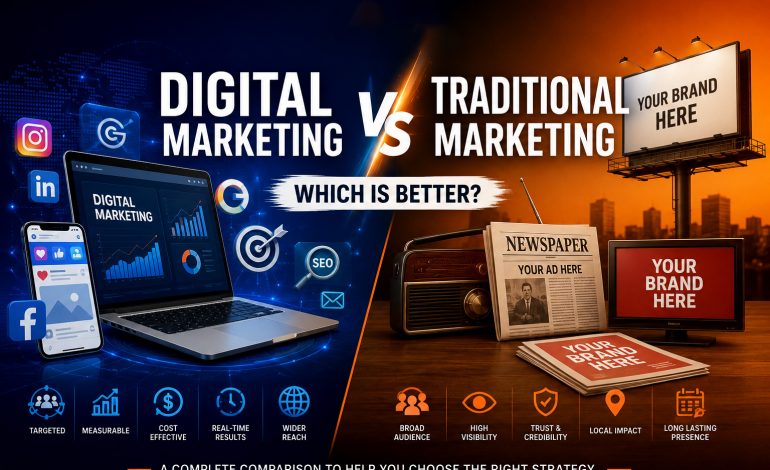

Digital Marketing vs Traditional Marketing—which one is better for your business? The answer depends on your audience, goals, budget, industry, and marketing strategy. However, in today’s increasingly connected world, digital marketing gives businesses powerful advantages in targeting, measurement, flexibility, and customer engagement.
Traditional marketing is still valuable, especially for businesses targeting local communities or audiences that respond strongly to offline media. But for most modern businesses, a digital marketing strategy is no longer optional—it is one of the most effective ways to build visibility, generate leads, increase sales, and compete in a crowded marketplace.
Your customers are already online. The real question is: Is your business visible where they are looking?
In this comprehensive guide, we will compare digital marketing vs traditional marketing, examine their advantages and disadvantages, compare their costs and ROI, and explain which marketing approach may be the best choice for your business.
What Is Digital Marketing?
Digital marketing is the promotion of products, services, brands, and businesses through digital channels and internet-connected platforms.
Businesses use digital marketing to reach potential customers through platforms they use every day, including search engines, social media, websites, email, mobile devices, and online advertising networks.
Common types of digital marketing include:
- Search Engine Optimization (SEO)
- Search Engine Marketing (SEM)
- Social Media Marketing
- Content Marketing
- Email Marketing
- Pay-Per-Click (PPC) Advertising
- Influencer Marketing
- Affiliate Marketing
- Video Marketing
- Local SEO
- Online Reputation Management
- Conversion Rate Optimization
For example, when someone searches Google for “best digital marketing agency in Pakistan” and discovers your business, that visibility can be generated through SEO, paid search advertising, content marketing, or a combination of digital strategies.
Why Digital Marketing Is Growing
Consumers increasingly research businesses, compare products, read reviews, watch videos, and communicate with brands online.
This creates a major opportunity for businesses.
Instead of simply putting an advertisement in front of a large audience, digital marketing allows businesses to:
Reach → Target → Engage → Convert → Measure → Improve
That measurable process is one of the biggest differences between digital and traditional marketing.
What Is Traditional Marketing?
Traditional marketing refers to marketing methods that existed before the widespread adoption of digital channels.
It generally uses offline communication methods to reach potential customers.
Examples include:
- Television advertisements
- Radio advertisements
- Newspaper advertising
- Magazine advertisements
- Billboards
- Brochures
- Flyers
- Posters
- Direct mail
- Business cards
- Outdoor advertising
- Print catalogs
- Event sponsorships
Traditional marketing can be highly effective when businesses want to establish broad awareness or reach people within a particular geographic area.
For example, a local restaurant may use billboards, flyers, banners, or newspaper advertisements to attract customers living nearby.
Digital Marketing vs Traditional Marketing: At a Glance
| Factor | Digital Marketing | Traditional Marketing |
| Medium | Internet and digital platforms | Offline media |
| Audience Targeting | Highly precise | Generally broader |
| Geographic Reach | Local to global | Often local or regional |
| Cost Flexibility | Highly flexible | Often requires larger upfront budgets |
| Measurement | Highly measurable | More difficult to measure precisely |
| Customer Interaction | Two-way and immediate | Usually one-way |
| Optimization | Campaigns can be changed quickly | Changes may be expensive or slow |
| Personalization | Highly customizable | Limited |
| Lead Tracking | Advanced tracking available | More difficult |
| Speed | Fast | Usually slower |
| Content Lifespan | Can remain searchable for years | Often temporary |
| Brand Building | Strong | Strong |
| Local Awareness | Excellent | Excellent |
| Scalability | Very high | More limited |
Digital Marketing vs Traditional Marketing: The Major Differences
Understanding the differences between digital and traditional marketing can help business owners decide where to invest their marketing budget.
1. Audience Targeting
One of the biggest advantages of digital marketing is precise audience targeting.
Digital advertising platforms can allow businesses to target audiences based on factors such as:
- Location
- Age
- Interests
- Online behavior
- Search intent
- Demographics
- Device
- Previous interactions with a website
- Customer characteristics
Traditional marketing usually reaches a broader audience.
For example, a billboard may be seen by thousands of people, but you may not know how many are interested in your product.
Digital advertising can be designed to reach a much more specific audience.
Better for precise targeting: Digital Marketing
2. Cost of Marketing
Marketing costs vary significantly depending on the industry, campaign, platform, location, and competition.
Traditional advertising can require significant upfront investment.
Television commercials, billboards, newspaper advertisements, and print campaigns may involve substantial production and placement costs.
Digital marketing can offer more flexible entry points.
A small business can start with:
- Organic SEO
- Social media content
- Google Business Profile optimization
- Email marketing
- Content marketing
- Small PPC campaigns
Businesses can then increase their investment as they identify strategies that generate results.
Better for flexible budgets: Digital Marketing
3. Measuring Results
This is one of the strongest advantages of digital marketing.
Digital campaigns can often track metrics such as:
- Website visitors
- Traffic sources
- Clicks
- Leads
- Conversion rates
- Cost per lead
- Cost per acquisition
- Engagement
- Search rankings
- Return on advertising spend
- Sales
Traditional marketing can be measured, but attribution is often more difficult.
For example, if someone sees a billboard and later visits your store, it may be difficult to know exactly whether the billboard caused that visit.
Digital analytics can provide much more detailed information about the customer journey.
Better for measurable performance: Digital Marketing
4. Customer Engagement
Traditional marketing is generally one-way communication.
A company publishes an advertisement, and the audience receives it.
Digital marketing allows businesses to communicate directly with customers.
Customers can:
- Comment
- Share
- Like
- Send messages
- Ask questions
- Leave reviews
- Subscribe
- Visit a website
- Download information
- Make purchases
This creates opportunities to build relationships rather than simply broadcast advertisements.
Modern marketing is not just about being seen. It’s about being remembered, trusted, and chosen.
Better for direct engagement: Digital Marketing
5. Speed and Flexibility
Suppose you launch a digital advertising campaign and discover that one advertisement is performing poorly.
You can potentially change:
- The headline
- Image
- Video
- Audience
- Budget
- Landing page
- Call-to-action
- Offer
Traditional advertisements are generally more difficult to change after publication or production.
A printed advertisement cannot easily be edited after thousands of copies have been distributed.
Better for flexibility: Digital Marketing
6. Geographic Reach
Digital marketing can allow a business to reach customers locally, nationally, or internationally.
A company in Pakistan can market its services to customers in:
- Pakistan
- United States
- United Kingdom
- Canada
- Australia
- United Arab Emirates
- Saudi Arabia
- And other international markets
Traditional marketing can also reach large geographic audiences, but expanding offline campaigns internationally can become considerably more expensive.
For businesses looking for international customers, digital marketing can be particularly powerful.
7. Brand Awareness
Both marketing approaches can build brand awareness.
Traditional marketing can create strong offline visibility through:
- Television
- Radio
- Billboards
- Events
- Print publications
Digital marketing builds awareness through:
- Search engines
- Social media
- Videos
- Blogs
- Online communities
- Digital advertising
The strongest brands often combine multiple channels rather than relying on only one.
Advantages of Digital Marketing
Digital marketing provides several important benefits to businesses.
1. Precise Targeting
Businesses can reach specific audiences rather than advertising to everyone.
2. Better Measurability
Digital analytics make it easier to understand what is working and what is not.
3. Flexible Budgets
Businesses can start small and scale successful campaigns.
4. Global Reach
A website can potentially reach customers around the world.
5. Faster Communication
Customers can interact with businesses immediately.
6. Personalization
Marketing messages can be customized for different audiences.
7. Search Visibility
SEO can help businesses attract people actively searching for their products or services.
8. Long-Term Content Value
A high-quality blog post, video, or SEO page may continue generating traffic long after publication.
Disadvantages of Digital Marketing
Digital marketing is powerful, but it is not effortless.
High Competition
Almost every business can establish an online presence, making competition intense.
Constant Changes
Search algorithms, advertising platforms, social media trends, and customer behavior continue to evolve.
Requires Skills
Successful digital marketing may require expertise in SEO, content, analytics, advertising, web development, design, and strategy.
Results May Take Time
SEO and content marketing can take months to produce significant results.
Reputation Risk
Negative reviews or poor customer experiences can spread quickly online.
Therefore, digital marketing should be treated as a strategic business investment rather than simply posting content on social media.
Advantages of Traditional Marketing
Traditional marketing continues to have an important role.
1. Strong Local Visibility
Billboards, banners, flyers, and local publications can be effective for geographically focused businesses.
2. Physical Presence
Printed materials can create a tangible connection with customers.
3. Broad Exposure
Television and radio can reach large audiences.
4. Brand Credibility
Certain traditional media can still provide credibility and recognition.
5. Effective for Certain Audiences
Some audiences respond better to offline communication than digital advertising.
Disadvantages of Traditional Marketing
Traditional marketing also has limitations.
Difficult Measurement
It can be challenging to determine exactly how many customers were generated by an advertisement.
Higher Upfront Costs
Some traditional campaigns require substantial investment before reaching an audience.
Limited Targeting
Traditional advertising generally provides less detailed targeting than digital platforms.
Limited Interaction
Customers cannot interact with a newspaper advertisement or billboard in the same way they can interact with a social media post.
Slower Optimization
Changing an offline campaign may require new printing, production, or placement.
Digital Marketing vs Traditional Marketing: Which Has Better ROI?
There is no universal answer.
ROI depends on your business model, target market, marketing channel, offer, execution, and customer journey.
For example, an e-commerce business may achieve excellent results through SEO, Google Ads, social media advertising, email marketing, and content marketing.
A local construction company may benefit from a combination of SEO, Google Business Profile optimization, social media, referrals, outdoor advertising, and local networking.
A large consumer brand may combine television, outdoor advertising, social media, influencer campaigns, search marketing, and events.
The important question is not:
“Which marketing method is universally better?”
The better question is:
“Which marketing channels reach my customers most effectively and generate profitable business?”
Digital Marketing vs Traditional Marketing for Small Businesses
For many small businesses, budget efficiency is critical.
Small businesses often cannot afford large television campaigns or expensive billboard networks.
Digital marketing provides several accessible options.
A small business can build its online presence through:
- A professional website
- SEO
- Google Business Profile
- YouTube
- Content marketing
- Email marketing
- Local SEO
- Paid search advertising
This gives smaller businesses an opportunity to compete for attention with larger companies.
For example, a local business can optimize its website for searches such as:
“best [service] near me”
or
“[service] in Lahore”
and potentially attract people who already have purchase intent.
Digital Marketing vs Traditional Marketing for Startups
Startups typically need three things:
Visibility + Trust + Customers
Digital marketing can help startups build all three.
A startup can publish useful content, establish social media profiles, optimize its website, collect customer reviews, create educational videos, and use targeted advertising.
Instead of spending an enormous amount on broad advertising, startups can test different messages and audiences before scaling their investment.
This creates a more data-driven approach to growth.
Is Traditional Marketing Dead?
No.
Traditional marketing is not dead.
The mistake is assuming that businesses must choose only digital or traditional marketing.
Some businesses can achieve stronger results by combining both.
For example:
Billboard → Brand Awareness → Google Search → Website → Lead → Sales
A customer may first discover a company through a billboard and later search for the company online.
This means offline and digital channels can support each other.
The modern customer journey is rarely limited to one marketing channel.
The Power of Integrated Marketing
The most effective strategy for many businesses may be an integrated marketing strategy.
This means combining online and offline marketing channels around the same business objectives.
For example:
Offline
- Billboard
- Business cards
- Flyers
- Events
- Print advertising
Online
- Website
- SEO
- Social media
- Google Ads
- Content marketing
- Email marketing
- YouTube
Together, these channels can create a stronger customer journey.
Don’t choose channels because they are popular. Choose them because your customers are there.
Digital Marketing vs Traditional Marketing: Which Should You Choose?
Consider digital marketing if your business needs:
- More website traffic
- Online leads
- Search engine visibility
- Social media growth
- International customers
- Measurable campaigns
- E-commerce sales
- Lead generation
- Online brand awareness
- Flexible advertising budgets
Traditional marketing may be useful if your business needs:
- Local mass awareness
- Physical visibility
- Community engagement
- Event promotion
- Broad offline exposure
- Audience reach through television or radio
For many businesses, the best answer is a combination of both.
Why SEO Is Particularly Important
Among all digital marketing channels, Search Engine Optimization (SEO) deserves special attention.
SEO helps businesses improve their visibility when potential customers search for relevant information, products, or services.
For example, a customer searching for:
“best digital marketing agency in Pakistan”
has already demonstrated an interest in the service.
If your business appears prominently in relevant search results, you have an opportunity to attract that potential customer organically.
SEO can help businesses build:
- Organic traffic
- Brand visibility
- Authority
- Trust
- Qualified leads
- Long-term online presence
Unlike an advertisement that stops generating traffic when the campaign ends, successful SEO content can continue attracting visitors over time.
Why Content Marketing Matters
Content marketing is another important component of digital marketing.
Businesses can create:
- Blog articles
- Guides
- Videos
- Infographics
- Case studies
- Tutorials
- Social media posts
- FAQs
Useful content can attract people at different stages of the buying journey.
For example:
Problem → Research → Comparison → Solution → Purchase
A business that provides helpful information throughout this journey can build authority and trust before asking for the sale.
The Future of Marketing Is Customer-Centric
Marketing is changing from mass communication toward personalized customer experiences.
Customers expect businesses to:
- Answer questions quickly
- Provide useful information
- Offer convenient communication
- Maintain an online presence
- Respond to reviews
- Provide transparent information
- Understand customer needs
Digital channels make these interactions easier to manage and measure.
The businesses that succeed will not simply advertise more.
They will understand their customers better.
Digital Marketing vs Traditional Marketing: Final Verdict
So, which is better—digital marketing or traditional marketing?
For most modern businesses, digital marketing offers significant advantages in targeting, measurement, flexibility, engagement, scalability, and cost control.
However, traditional marketing remains useful for certain industries, audiences, and objectives.
The smartest approach is not necessarily choosing one and eliminating the other.
The winning strategy is:
Use traditional marketing to create awareness where it works.
Use digital marketing to capture attention, build trust, generate leads, and measure results.
At Creators Pakistan, we believe marketing should be driven by strategy—not guesswork.
A successful marketing campaign begins with understanding your:
Audience → Competition → Goals → Offer → Channels → Content → Data → Results
When these elements work together, marketing becomes more than advertising.
It becomes a growth engine.
Ready to Grow Your Business With Digital Marketing?
Your competitors are already building their online presence.
Your customers are already searching.
Your audience is already scrolling.
The question is whether your business will be visible when they are ready to buy.
At Creators Pakistan, we help businesses build stronger digital identities through strategic digital marketing services, including:
- SEO Services
- Social Media Marketing
- Website Development
- Content Marketing
- Digital Advertising
- Graphic Designing
- Business Promotion
- Digital Strategy
Don’t just advertise. Build a digital presence that generates opportunities.
Creators Pakistan — Turn Your Digital Presence Into Business Growth.
Ready to take your business online? Contact Creators Pakistan today and start building a marketing strategy designed around your business goals.
Frequently Asked Questions
Is digital marketing better than traditional marketing?
Digital marketing is often more flexible, measurable, and targeted than traditional marketing. However, the best approach depends on the business, audience, budget, and marketing objectives.
Which is cheaper: digital marketing or traditional marketing?
Digital marketing can be more budget-friendly because businesses can start with relatively small campaigns and scale them according to performance. However, actual costs vary by channel and competition.
Which marketing method provides better ROI?
There is no universal answer. ROI depends on the business, audience, offer, campaign strategy, execution, and measurement. Digital marketing often provides stronger tracking capabilities.
Is traditional marketing still effective in 2026?
Yes. Traditional marketing remains useful for brand awareness, local campaigns, events, outdoor advertising, television, radio, and specific audiences.
Can digital and traditional marketing be used together?
Absolutely. An integrated marketing strategy can combine offline awareness with digital channels for engagement, lead generation, conversion, and measurement.
Why is SEO important for digital marketing?
SEO helps businesses appear in relevant search results and attract users who are actively looking for information, products, or services.
Which marketing is better for a small business?
For many small businesses, digital marketing is an attractive starting point because it offers flexible budgets, precise targeting, measurable results, and the ability to reach local or international audiences.
How can Creators Pakistan help my business?
Creators Pakistan provides digital marketing solutions including SEO, social media marketing, website development, content marketing, graphic designing, digital advertising, and business promotion to help businesses strengthen their online presence and generate growth opportunities.